
AI shoplifting detection: The technology behind AIn-Guard
How AIn-Guard analyses movement in connected camera footage, sends short video alerts and draws on research to support shoplifting prevention.

AI-generated illustrative image. The phone screen is a schematic representation.
At the till, a customer needs help. A delivery has arrived. Someone is waiting with a question. Your cameras keep recording, but your attention is already occupied.
AIn-Guard analyses footage from connected cameras and sends a short video clip when it flags unusual movement. You can see what triggered the message and decide whether the situation needs your attention.
That is the practical purpose of the technology: helping you keep an eye on your shop while you run it.
From recording a scene to highlighting a moment
Finding an incident in recorded footage takes time. You need to know where to look and roughly when it happened. An alert with the relevant clip gives you a starting point.
AIn-Guard looks for movement patterns that may warrant a closer look—for example, a sequence that resembles someone concealing an item under their clothing.
The clip gives staff the opportunity to check the scene. What happened before the movement? Is the item still visible? Is there an ordinary explanation?
An alert brings the moment to your attention. Your team assesses the situation.
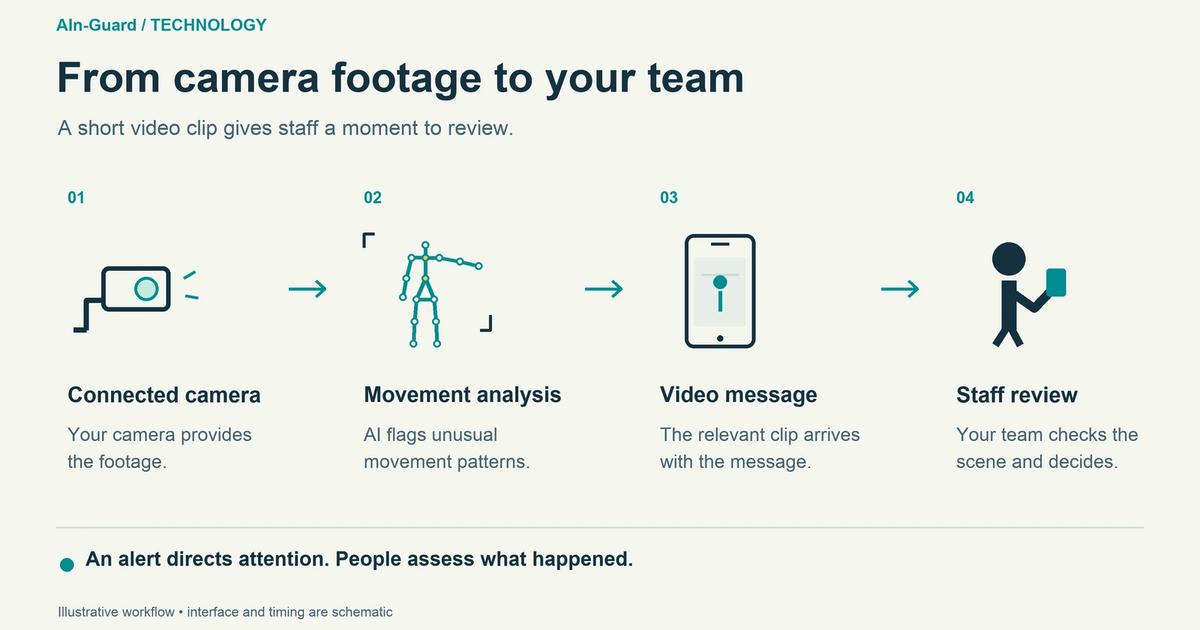
Open the full-size infographic
How AI can analyse human movement
One approach to analysing movement is pose estimation. It represents parts of the body—such as shoulders, elbows, wrists and hips—as points within an image.
Following those points across several frames produces a simplified description of movement. A model can then analyse a sequence rather than relying on a single image.
This matters because ordinary shopping involves many different movements. People reach across shelves, adjust their clothing, pick up bags and put products back. A raised arm or a hand near a pocket cannot establish someone’s intention.
Our research examines how movement sequences can be scored to support human review, and how reliably that approach transfers to unfamiliar footage.
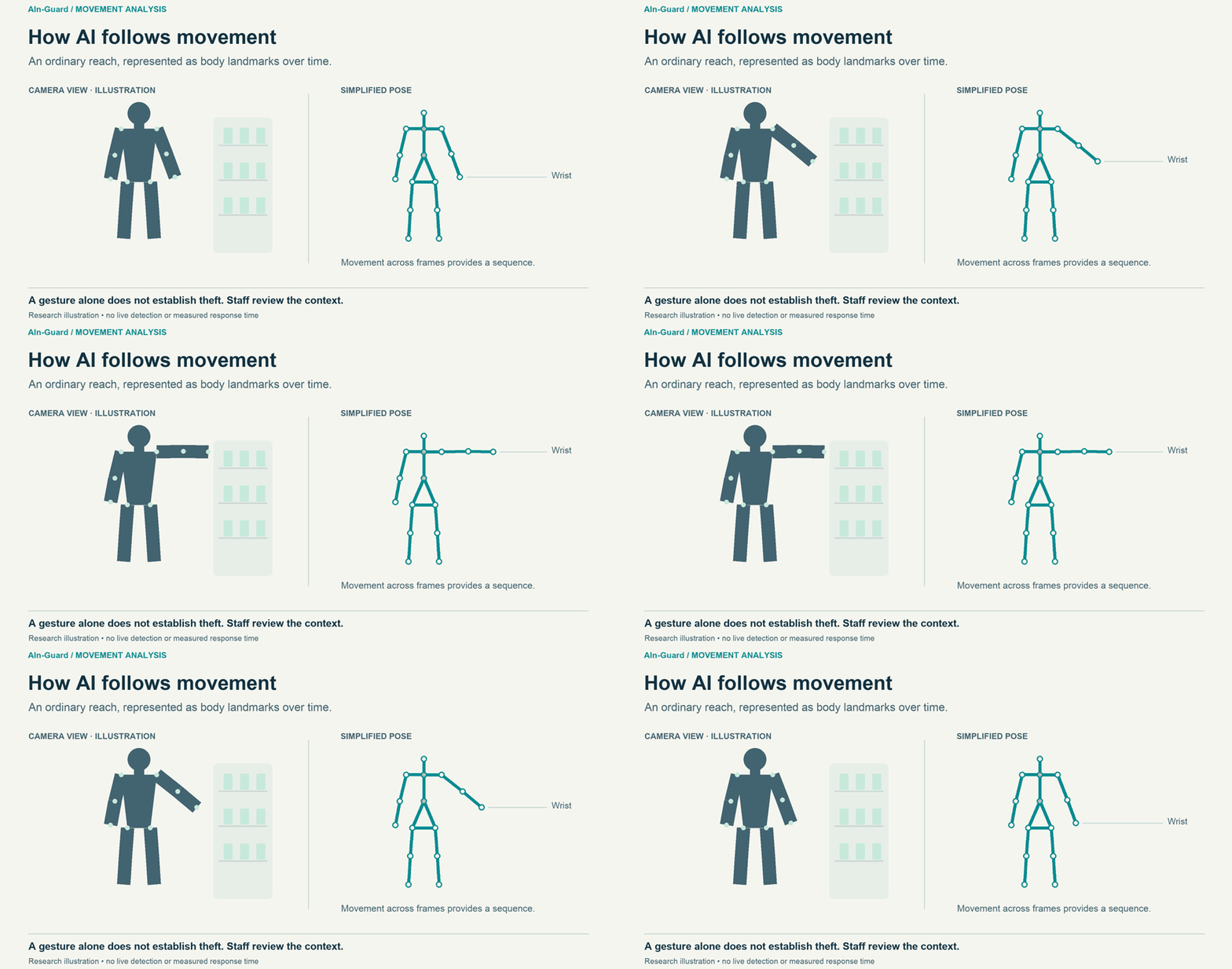
View the animation at full size
Research developed by the people behind AIn-Guard
We developed AIn-Guard’s technology from the ground up. Our CTO (PhD, Kyoto University) created the AI models.
His work with co-author Mohamed ElBassat includes a peer-reviewed study published in Signal, Image and Video Processing in October 2026. It investigates a compact model for analysing pose sequences associated with potentially suspicious behaviour in retail video.
The study also examines an important practical challenge: performance on unfamiliar footage. Its external benchmark results were mixed, and confidence-based training did not consistently improve those results.
Those findings help identify where further development and testing are needed. They are research results, rather than a measurement of AIn-Guard’s performance in an individual shop.
Read the published study and its findings.
What matters when the technology reaches your shop
A useful security system has to work with the conditions in front of it.
Camera position affects what is visible. Shelves, clothing and other people can obscure a movement. A crowded aisle presents different challenges from an empty one.
The complete workflow matters too. Does a message arrive while it is still useful? Does the clip show enough context? How often does a member of staff spend time checking a situation that turns out to be ordinary?
These are the questions that connect AI development to the daily work of protecting a business. Model results are one part of that evaluation; the usefulness of the information reaching staff is another.
A short clip that fits into the working day
Not every small shop can employ a dedicated store detective. Owners and staff still need a way to notice situations while serving customers, handling deliveries and keeping the business moving.
With AIn-Guard, the message includes a short video clip of the flagged moment. You can review the scene without first searching a long recording for the event that triggered the alert.
Reviewing messages still takes attention. The aim is to give that attention a useful focus.
See how the video-alert workflow fits into a small shop.
Connecting technology to loss prevention
Stock on a shelf represents money your business has already spent. When it disappears, the financial effect can extend beyond the value of one missed sale. Our shoplifting-loss calculation explains that relationship through a concrete price example.
Questions about insurance cover and the handling of a loss deserve their own careful explanation. We cover those in our article on shoplifting and insurance in Austria.
Here, the role of the technology is to help staff notice and review relevant situations. A useful alert can support an appropriate response while an event is still unfolding. The opportunity to prevent a loss depends on what the cameras capture, what the system flags and what happens next in the shop.
Let’s help you protect your shop
Tell us where you need a better view of what is happening and how your team works. We can discuss connecting your cameras, show you the video-alert workflow and work out what makes sense for your business.

